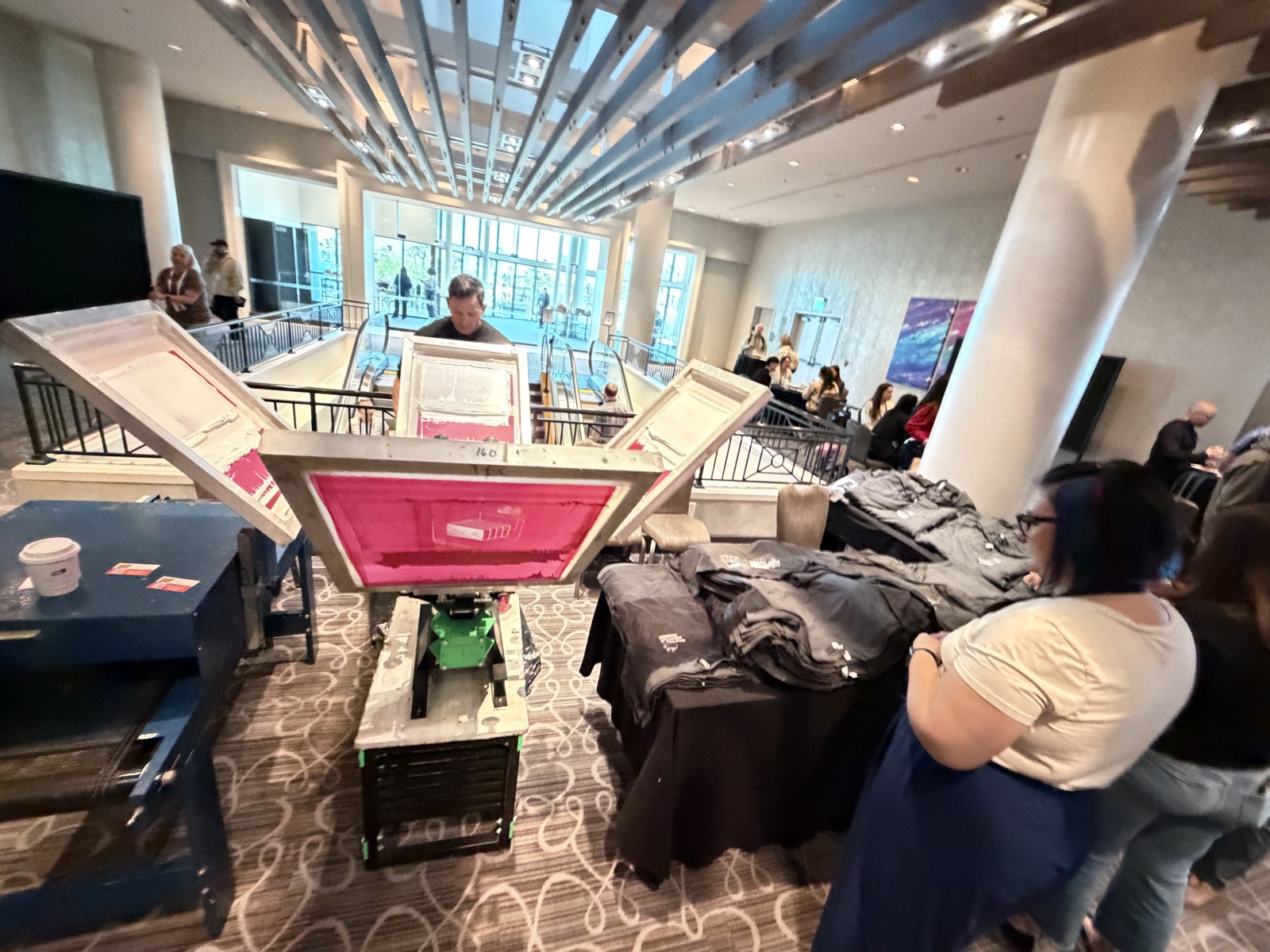
"How fast is it?" is the first question almost every event producer asks about on-demand t-shirt printing, and on its own it is the wrong question. The press itself is rarely the bottleneck. What decides whether your station feels fast is the whole pipeline around it: how guests place orders, how blanks are staged, how artwork is selected, and how finished shirts get back into the right hands. Merch Troop runs these stations live at corporate events, trade shows, and brand activations across Orange County, Los Angeles, San Diego, Las Vegas, and nationwide, and the numbers below come from the floor, not a spec sheet.
Real per-shirt press times by method
Different decoration methods carry different cure and handling times. Heat-applied transfers and DTF (direct-to-film) are the workhorses of live printing because a single shirt presses in well under a minute and needs no screen setup between designs.
- DTF / heat transfer: roughly 15–40 seconds of press time per shirt once the film is positioned, plus a few seconds to load and peel.
- Screen printing (live): fast per pull, but the setup, registration, and screen changes between designs make it best for one or two locked graphics, not constant variety.
- Embroidery: several minutes per piece — premium for hats and polos, but not a high-volume live option.
- Sublimation / UV DTF: excellent for specialty products, with handling times that depend on the substrate.
For a true on-demand line, DTF and heat transfers do the heavy lifting. The single-shirt press time is short enough that the press almost never becomes the limiting factor.
Station throughput: shirts per hour
A single well-run heat-press station with one operator and one runner comfortably moves 40–60 finished shirts per hour in sustained production. Push past that and you are no longer limited by the press — you are limited by the line, the order intake, and how cleanly art is being chosen.
Why throughput plateaus
Throughput stops scaling for predictable reasons:
- Guests deliberating over size or design at the front of the line.
- Custom personalization (names, numbers) that adds a layout step per shirt.
- A single press doing the work of two during a rush.
The fix is rarely a faster machine. It is a second press, a dedicated order-taker, and a tighter art menu — which is exactly how we scale a station up for a peak crowd.
The line decides how fast it feels
Two stations can have identical press times and feel completely different to a guest. Perceived speed is about flow, not seconds. When a guest places an order, gets a name on the queue, and walks away to grab a drink while their shirt prints, a four-minute wait feels effortless. When they stand in one line watching a single operator, even a two-minute wait feels slow.
We plan around the line, not just the machine. The press time is fixed; the experience is designed.
That is why our setups separate order intake from production from pickup. Each guest request becomes a tracked production ticket, so sizes, art, and pickup timing stay clean from the first scan to the final handoff.
Turnaround math for your event
To estimate whether a single station can serve your crowd, work backwards from total event hours:
- Take your printing window in hours (say, a 4-hour activation).
- Multiply by realistic throughput (50 shirts/hour) for about 200 shirts from one station.
- Compare against expected takers. If 400 of 600 guests will want a shirt, you need two stations or a longer window.
This is the single most useful calculation in planning a live print activation, and it is the first thing Merch Troop runs when we spec a station, crew size, and product plan for a quote.
How staffing changes the numbers
Crew size is the biggest lever on real throughput. A lone operator does everything — takes the order, presses, and hands off — which caps a station well below its potential. Add a runner and an order-taker and the same press jumps toward its ceiling because the operator never stops pressing. For high-traffic windows we staff multiple presses with dedicated roles so the line keeps moving even at peak, then scale back down for the slower stretches.
It is also worth planning for the shape of the rush, not just the average. Most events do not draw a steady trickle — they spike around a keynote break, a happy hour, or the close of an expo floor. A station sized only for the average will fall behind exactly when the most people are watching. We plan capacity against the peak window and use timed graphic drops to spread demand, so the line stays manageable instead of all arriving at once. Get the staffing, the product staging, and the queue right, and a live print station feels fast no matter how deep the line gets — which is the real answer to "how fast is it?"