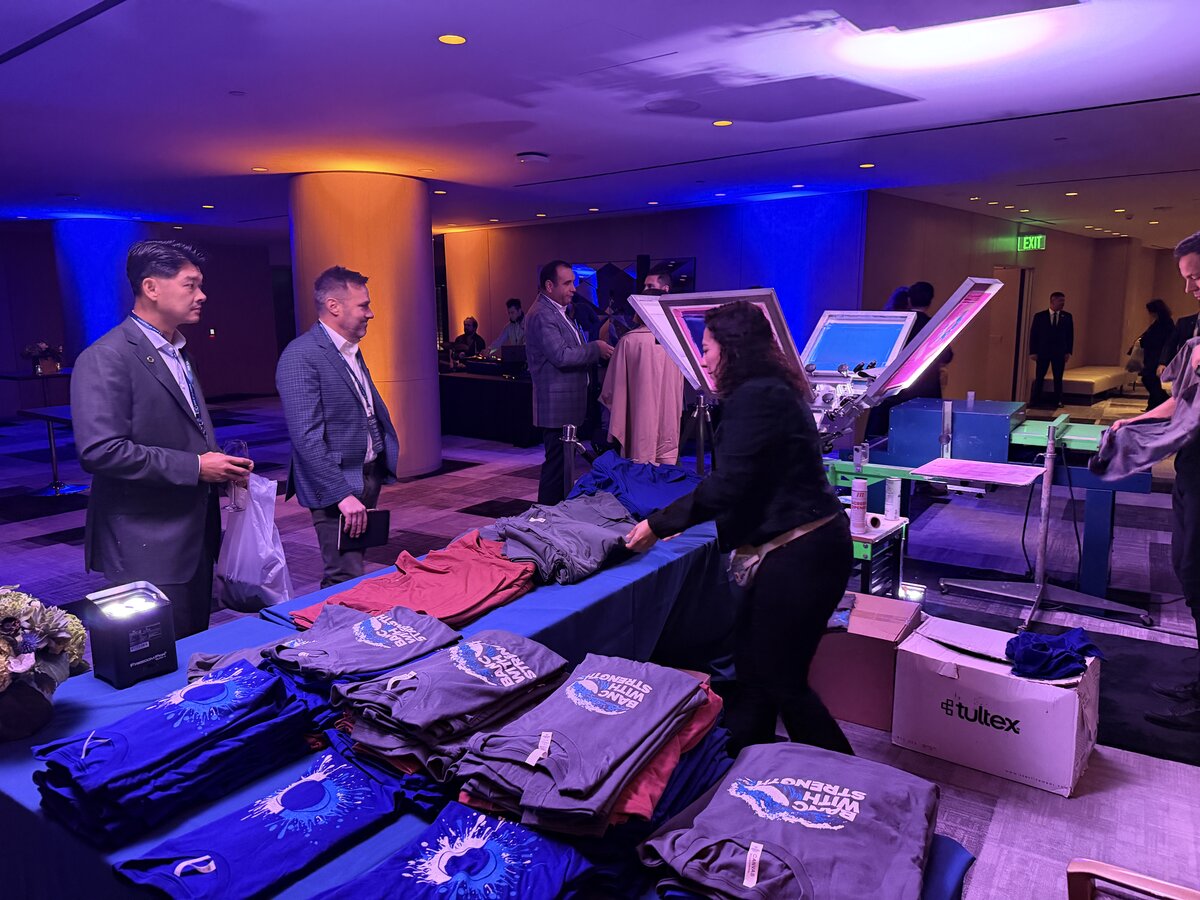
A live on-demand t-shirt printing station looks effortless when it is planned right and chaotic when it is not. The difference is almost never the equipment — it is the footprint, the guest path, the art menu, and the run-of-show decided weeks before load-in. This guide walks through how Merch Troop plans a station from first inquiry to last pickup so it produces cleanly all event long. We run these activations across Orange County, Los Angeles, San Diego, Las Vegas, and nationwide, and the same planning spine works at a 75-person mixer or a 2,000-person conference.
Footprint, power, and placement
Before anything else, lock the physical setup with your venue. A standard single-press station needs roughly a 10x10 footprint for the press, a folding table for intake, blank storage underneath, and clear space behind for the operator to work without bumping the line.
What to confirm with the venue
- Power: heat presses draw real amperage. Confirm dedicated circuits so you are not tripping breakers mid-rush.
- Placement: a high-traffic but not bottlenecked spot — near an entrance or bar, but never blocking a fire lane.
- Load-in: dock access, elevator dimensions, and the time window for setup and teardown.
- Surface and ventilation: a stable floor and reasonable airflow for cure-time comfort.
Design the guest path
The single biggest planning decision is how a guest moves through the station. The goal is to split order intake, production, and pickup into three points so no one is standing still watching a press. A guest places an order, gets a name on the live queue, steps aside, and is called back when the shirt is ready.
One controlled queue, not a pile of loose requests. Every guest request becomes a tracked production ticket.
This is what keeps a deep line feeling fast. It also prevents the most common failure mode: a crowd clustering directly in front of the press and stalling production. Give the queue a little physical room — a side rail or a marked waiting zone — so guests have somewhere to be that is not on top of the operator. The moment people can place an order and step away, the perceived wait drops even when the actual press time has not changed at all.
Build a tight art menu
Variety feels generous but it slows everything down. A focused menu — a handful of pre-approved event graphics plus one or two personalization options — is faster to run, easier to staff, and cleaner for guests to choose from. Plan around:
- Locked event graphics: the brand or campaign art, print-ready and color-corrected ahead of time.
- Timed drops: limited graphics released at set times to create buzz without ever stalling the line.
- Personalization: names or numbers, scoped so the layout step does not balloon per-shirt time.
Plan products and sizing
Choose blanks that press fast and look premium on the table, then order a size curve that matches your crowd. A typical run weights heavily toward M, L, and XL with smaller counts of S, XS, and 2XL+. Over-ordering the common sizes is far cheaper than running out at hour two. Merch Troop sources tees, soft-style shirts, hoodies, hats, and staff gear and stages them so size runs never stall the activation.
Write the run-of-show
A run-of-show maps the station to the event timeline so the crew knows what happens when:
- Load-in & setup: arrive early enough to build, test the press, and stage blanks before doors.
- Soft open: first guests, confirm flow, catch any kinks while volume is low.
- Peak window: the rush — this is where staffing and a second press earn their keep.
- Timed drops: scheduled graphic releases to re-energize the line.
- Last call & teardown: a clean cutoff for new orders, finish the queue, strike the booth.
Staffing the station
Match crew to the run-of-show, not a flat headcount. A quiet mixer might run on one operator and a helper; a peak conference window needs dedicated order-takers, multiple press operators, and runners so the line keeps moving. Plan staffing hours to include setup and teardown, since those are real labor even when no guest is watching. Merch Troop scopes the crew to the throughput target and the venue, then handles travel and logistics around it.
A few habits separate a smooth station from a stressful one. Test the press and run a few sample shirts before doors so any positioning or temperature issues are solved early. Pre-stage blanks by size so the operator never hunts for inventory mid-rush. Brief the crew on the run-of-show and the timed drops so everyone knows when the peak is coming and who owns intake, pressing, and pickup. And set a clear last-call for new orders before the event ends so the queue finishes clean instead of leaving guests waiting on shirts after teardown begins. None of this is complicated, but planned together it is the difference between a station that feels effortless and one that scrambles all night.