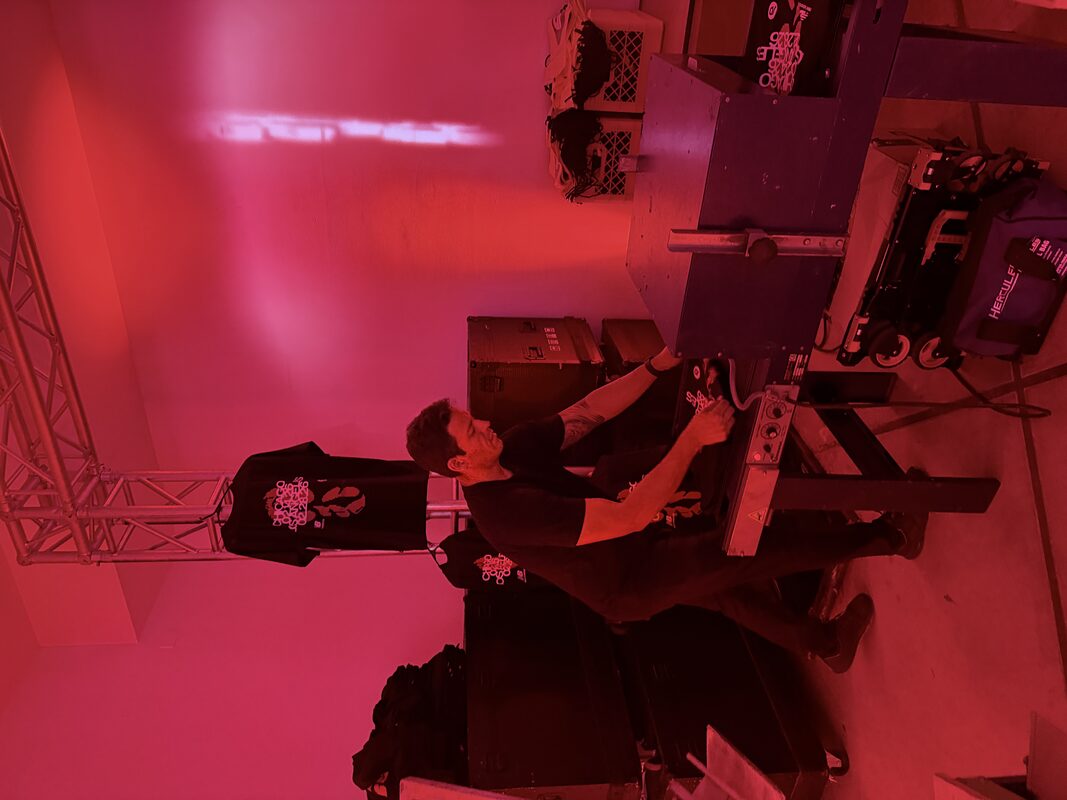
"How much does on-demand t-shirt printing cost?" rarely has a one-number answer, because a live print station is a service, not a product off a shelf. The price reflects the crew, the hours, the products, and the logistics of putting a working press in front of your guests. Understanding the inputs makes the quote far less mysterious — and helps you make trade-offs that fit your budget. Below are the factors that actually move the number when Merch Troop scopes an activation for events across Orange County, Los Angeles, San Diego, Las Vegas, and nationwide.
Event hours and the production window
The length of your printing window drives almost everything downstream. Longer windows mean more staffing hours, more blanks to stock, and sometimes a second station to keep pace. Critically, the quote covers more than guest-facing time:
- Setup: load-in, booth build, and press testing before doors.
- Live production: the active printing window.
- Teardown: striking the booth and load-out.
Setup and teardown are real labor even when no guest is watching, so they belong in any honest quote. A short, well-attended window can actually be more cost-efficient than a long, sparse one, because the crew and equipment are mobilized either way — concentrating the demand into a focused window often gets you more shirts pressed per dollar than stretching the same crew across a slow day.
Staffing and crew size
Labor is typically the largest line item, and it scales with the throughput you need. A quiet activation might run on a small crew; a high-traffic peak window needs dedicated order-takers, multiple press operators, and runners so the line keeps moving. More crew costs more, but it is exactly what prevents the slow, single-operator bottleneck that frustrates guests. Staffing is priced by the hours worked, including setup and teardown time.
The honest trade-off here is throughput versus budget. Understaffing to save money usually backfires: the line slows, guests walk away, and the merch that was meant to drive engagement sits unprinted. The better move is to staff the peak and scale down for the quieter stretches, which is why we map crew to the run-of-show instead of charging a flat headcount for the whole day. If the budget is tight, it is almost always smarter to shorten the window or trim the product menu than to thin the crew during the rush.
Products and whether we source the blanks
Garment cost is a direct input. A standard cotton tee is economical at volume; soft-style shirts, hoodies, and hats carry higher per-unit costs and raise perceived value. Two things shape this line:
- Product mix: premium blanks and outerwear cost more than basic tees.
- Sourcing: whether Merch Troop sources and stages the blanks or you provide them.
A tight, well-chosen menu keeps product cost predictable and avoids paying for inventory that never gets pressed.
Artwork and production prep
Print-ready art does not happen by accident. Logos and graphics often need to be cleaned up, color-corrected, sized, and converted to a press-ready format before the event. Timed drops and personalization (names, numbers) add prep and on-site layout steps. This prep is usually modest relative to staffing, but it is real work that protects print quality on the floor. Supplying clean, high-resolution artwork ahead of time trims this line item and removes a common source of day-of surprises — a logo pulled from a website at the last minute almost always needs rework before it presses well.
Travel and logistics
Where your event sits relative to our Southern California crew base matters. Local events in the OC, LA, and San Diego corridor carry little to no travel cost. Events farther out — Las Vegas or nationwide programs — add travel, lodging, and equipment transport. Planning travel-heavy events with enough lead time keeps these costs efficient, since rushed logistics tend to be the expensive kind. For programs well outside the local corridor, more lead time also opens up options for sourcing blanks closer to the venue, which can offset some of the travel overhead.
A real quote should include setup, teardown, operators, equipment, products, and production prep — not just a per-shirt rate.
How the inputs come together
When Merch Troop builds a quote, the inputs combine into a clear plan rather than a mystery total:
- Scope the window: setup, live hours, and teardown.
- Size the crew: staffing to hit your throughput target.
- Spec products: the blank mix and size curve for your crowd.
- Prep artwork: press-ready graphics, drops, and personalization.
- Add logistics: travel, lodging, and equipment if needed.
Send those details once and we usually return a full plan and quote within 24 hours, with the assumptions spelled out so you can adjust the scope to fit your budget.